The knowledge of service rules in badminton is very important to not be called for faulty services. An illegal service not only costs vital points, but also the lapse of concentration is not good for the health of your gameplay. At the early stage, you should be aware of the badminton serving rules to make it a habit in the subsequent stages to deliver proper service, following all the rules and regulations as guided by the BWF (Badminton World Federation).
My previous article, “Badminton Rules for Singles and Doubles Game,” is about the generalized ideas on every rule, whereas this article only concentrates on the serving rules.
General Serving Rules in Badminton for Singles and Doubles
The following are the general service rules that apply to both singles and doubles.
The server and receiver must stand in their respective service courts (which are diagonally opposite) without touching any lines.
At the time of serving, some parts of both feet of the server and receiver must be in touch with the ground until the shuttlecock is hit.
The shuttle should be below the server’s waist height when serving. This common practice is being widely followed in recreational and club-level tournaments. In 2018, BWF introduced a new fixed height system in the badminton serving rules for international tournaments. “The whole of the shuttle shall be below 1.10 meters from the surface of the court at the instant of being hit by the server racket.”
The racket head and the shaft must be pointed downwards at the instant of delivering the service.
After taking the initial backswing, the movement of the racket should be a continuous forward motion.
While serving, your racket must strike the base of the shuttle, i.e., the cork. You are not allowed to hit feathers and take advantage of the extra amount of spins during service.
You are not allowed to move while delivering service
After hitting, the shuttlecock’s flight should take an upward trajectory, aiming towards the diagonally opposite half of the service court.
If you miss the shuttle, the service is considered to be delivered.
A service should not be attempted until the receiver is ready. Once the server and receiver are ready, there should not be any further delay.
What are the Badminton Service Court Rules in Singles?
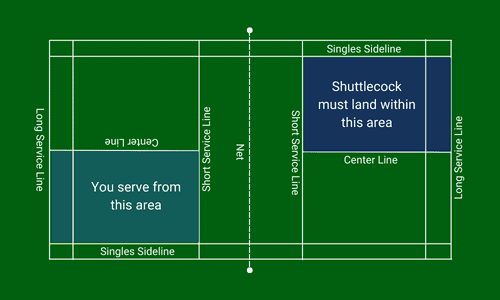
The area bounded by the short service line, long service line, center line, and the singles sideline is the service court in singles.
There are two service courts in each half, i.e., the right service court and the left service court. To be a valid service, the shuttlecock must land within the receiver’s service court if not intercepted by the receiver.
Any service before the short service line or beyond the long service line is considered wrong. Likewise, if the shuttlecock lands outside the centerline or the singles sideline, it is also a wrong service.
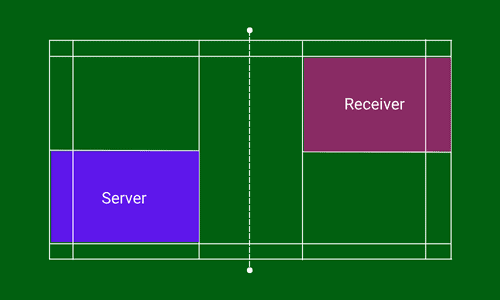
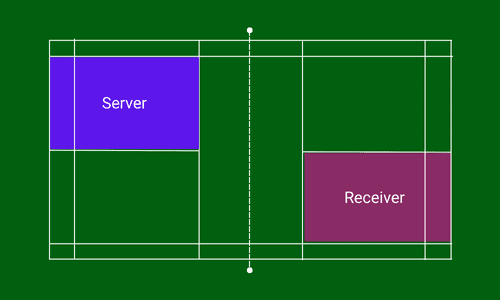
The service will be taken from the right service court if the serving player’s score is an even number (0, 2, 4, …). The receiver stands on the diagonally opposite service court to the server.
It is just the reverse when the server’s score is an odd number (1, 3, 5, …). He will serve from the left service court to the receiver standing diagonally opposite the service court, i.e., his left service court.
What are the Badminton Service Court Rules in Doubles?

The service court in doubles is different from that in singles. The doubles service court is surrounded by four lines, i.e., the short service line, the long service line, the centerline, and the doubles sideline. The area bounded by these 4 lines represents the doubles service court.
Lengthwise, a doubles service court is shorter than a singles service court. So for doubles, you should take care of high services that may go beyond the long service line, but may be well in for singles.
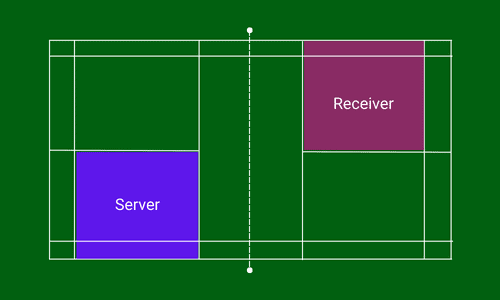
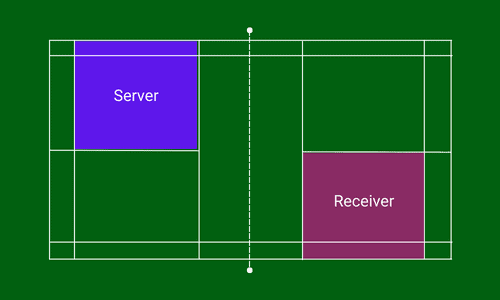
The same rules of singles also apply in doubles. For even points (0, 2, 4, and so on), you have to serve from the right service court, and for odd points (1, 3, 5, …), it is the left service court. For doubles, the switching of service courts looks a bit confusing. So I have presented it with examples and pictures to make it convenient for you.
Suppose two teams, X and Y, take part in a doubles match. Team X consists of players A and B, whereas Team Y consists of C and D.
Only players of the serving team who win the point exchange their respective service courts. If the receiving team wins the point, all players of both teams remain in the same service courts.
Sequence 1
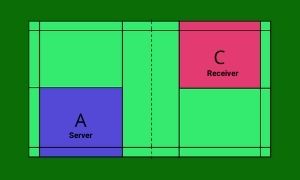
Player A of team X serves first from the right service court (as the score is an even number, i.e., 0-0). Player C of team Y is on the right service court, which is diagonally opposite player A.
Sequence 2
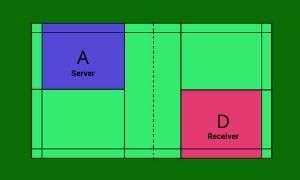
Team X wins the point. So player A takes the opportunity to serve from the left court (as the score is an odd number, i.e., 1-0) to D, the player of the opposite team, Y, standing on the left service court.
Sequence 3
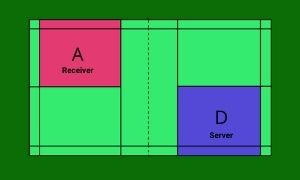
The receiving team, Y, wins the next point. So all players remain in the same courts, and D serves from the left service court ( Score is 1-1, an odd number) to player A of team X.
Sequence 4
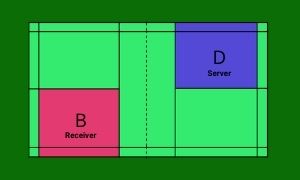
Team Y wins the point. So the players of team Y exchange their positions, and D serves from the right service court (Score is 1-2, an even number) to player B standing on the diagonally opposite service court.
Sequence 5
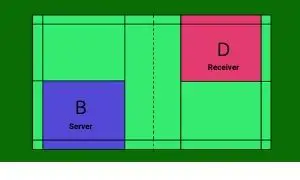
The receiving team, X, wins the next point. So B is the new server and serves from the right service court (Score an even number, i.e., 2-2) to D of team Y.
The sequence of serving and receiving will continue in this pattern till the match ends.
What are the Service Court Errors?
- If a server/ receiver serves or receives out of their turn
- If the server/ receiver is in the wrong service court while delivering/ receiving the service.
If a service court error is identified after the delivery of the next service, it is not to be corrected. If it is discovered before the next service, the following actions shall be taken.
- If the faulty side (server or receiver) wins the rally, the service is replayed with corrected positions.
- In case the error is made by both sides, the service is retaken with corrections.
- If the faulty side loses the rally, the error will not be corrected, and play will continue with the same score without changing the corrected service courts.
What is ‘let’ in Service?
A let serve occurs when the service is interrupted and replayed with the existing points. There are some situations when a service is called, let.
- If the service is delivered before the receiver is ready
- If some feathers get separated from the base
- If both server and receiver are on the wrong service court
- If the winner of a rally (server or receiver) is on the wrong service court
- If the shuttlecock passes the net but gets stuck on the top of the net
Who serves first in badminton?
In the opening set, the winner of the toss has the opportunity to serve first. For the 2nd and 3rd sets, the winner of the previous set serves 1st in the following set. This follows the badminton serving rules.
The simplicity is that when you win a set, you have also won the last point. So you will start serving the next set because you are the winner of the last point.
What happens if the shuttlecock clips the net but drops inside the service box?
This type of occurrence generally happens during the low serve when you have to be precise on the shuttle trajectory. In this case, there is no deviation from the general serving rules. If the shuttlecock falls short of the short service line, your opponent wins the point; otherwise, it is perfectly right when the shuttlecock is inside the service court.
Can you move during a service?
No player (server or receiver) is allowed to move their feet off the ground before the server hits the shuttlecock. The instant the server hits the shuttlecock, both players may move their feet off the ground.
Is it the right service if the shuttlecock lands on the line?
All lines of a service court are parts of the service area. When you hit a shuttlecock, the head of the shuttle lands first. If the head of the shuttlecock touches the lines of a service court, it is considered in.
Where does the doubles partner of the server/ receiver stand during a service?
There are clear instructions regarding the court position of the server or receiver. For an even score, the server serves from the right service court, and for an odd score, the service is taken from the left service court. But there are no such rules about the positions of their partners. They may stand anywhere within the respective courts as long as they don’t obstruct the vision of the receiver or server.
Related Topic: